
Researchers from the Institute of Metal Research (IMR) of the Chinese Academy of Sciences have stretched a chain of gold atoms by a record-breaking 46%, providing direct evidence of how fundamental metal bonds behave under extreme deformation. This study also reveals how structural changes at the atomic scale influence electrical transport.
The study, published in the Journal of the American Chemical Society on January 12, focuses on gold atomic chains—the ultimate one-dimensional structures in which atoms are linked in a single row.
Using an aberration-corrected high-resolution transmission electron microscope, the researchers meticulously stretched these atomically thin wires while simultaneously observing their structural changes with atomic precision in a clean, contamination-free environment.
The findings reveal dramatic and non-linear behavior. While the bond lengths stretched uniformly at low strains, strain exceeding 12% triggered a remarkable shift. The bonds no longer elongated uniformly. Instead, they exhibited a "discrete" or step-like stretching pattern, characterized by alternating short and long bonds, a configuration known as dimerization.
Strikingly, this extreme structural transformation profoundly impacted electrical conductance. As strain increased, the flow of electrons through the atomic chain underwent a stepwise transition. It dropped from well-known integer quantum conductance values to fractional quantum values. Eventually, under the highest strains, the chain became insulating. The direct correlation between specific atomic configurations (bond lengths) and distinct quantum conductance states establishes a new principle for controlling electrical properties at the atomic scale.
The discovery of this strain-controlled quantum conductance switching mechanism opens new avenues for designing next-generation electronic devices. It provides a foundational concept for developing ultra-miniaturized components, such as atomic-scale switches, memory elements (memristors), and quantum point contacts. This innovation could drive advancements in fields ranging from high-density data storage to quantum computing.
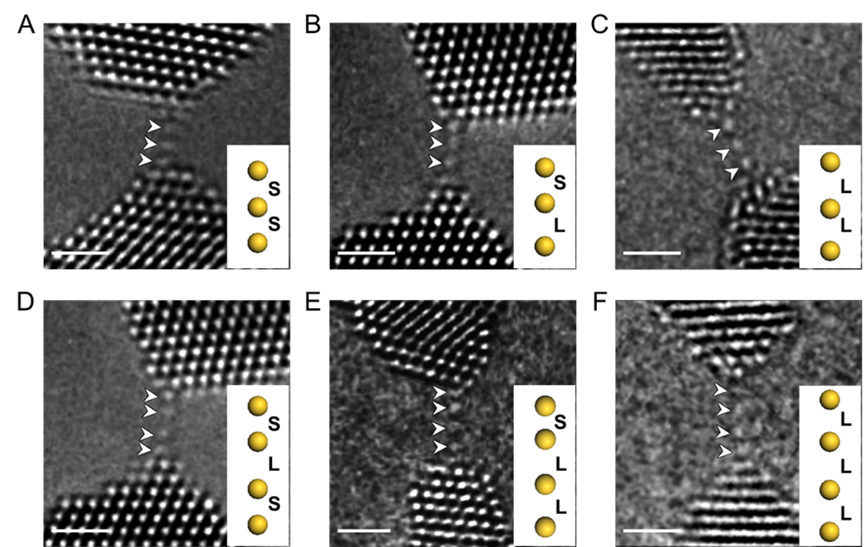
Aberration-corrected high-resolution transmission electron microscopy images of atomic chains with different configurations. (Image by IMR)
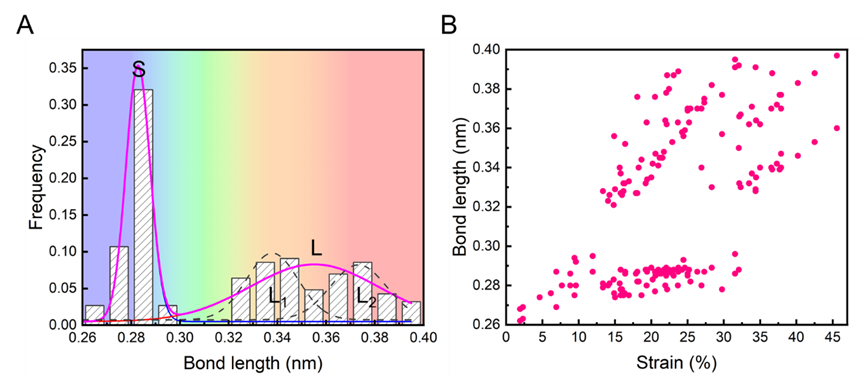
Bond length distribution in gold atomic chains. The bond lengths exhibit a discrete distribution, concentrated in two distinct ranges: 0.260–0.296 nm (short bond S) and 0.321–0.397 nm (long bond L). (Image by IMR)
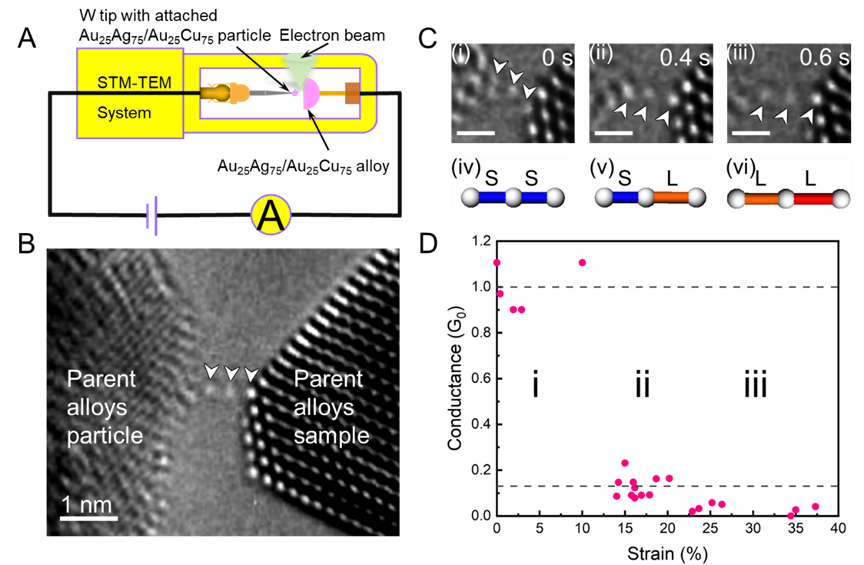
In situ observation and measurement of structural and conductance changes in a gold atomic chain. As strain increases and the atomic chain evolves from the S–S configuration through the S–L configuration to the L–L configuration, its conductance decreases stepwise, corresponding successively to the integer quantum level of 1G₀ (where G₀ = 2e²/h is the fundamental unit of quantum conductance), a fractional quantum state of 0.13G₀, and finally approaching zero to become an insulating state. (Image by IMR)
The successful fabrication of many modern optoelectronic devices including touch screens, organic light-emitting diodes, electronic displays, and solar cells, requires electrodes flexible, transparent and with high conductivity. To address extremely flexible transparent c...
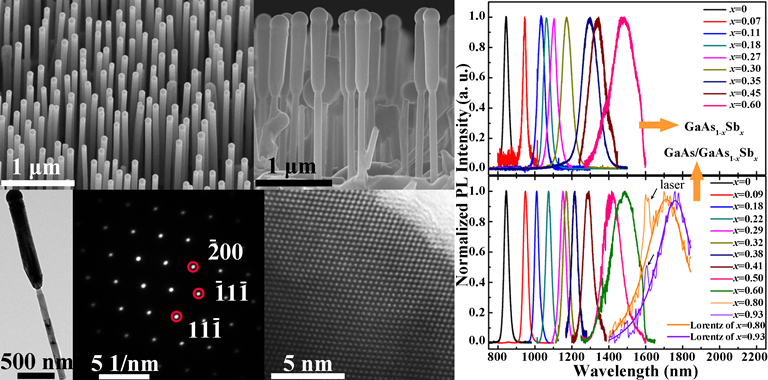
Recently, a research team led by Prof. ZHAO Jianhua, at the State Key Laboratory of Superlattices and Microstructures, Institute of Semiconductors, Chinese Academy of Sciences, demonstrated their collaborative work on the successful growth of near full-composition-range h...

86-10-68597521 (day)
86-10-68597289 (night)

52 Sanlihe Rd., Xicheng District,
Beijing, China (100864)
Copyright © 2002 - Chinese Academy of Sciences


